Knicks vs 76ers Match Player Stats: Complete Game Analysis, Top Scorers and NBA Highlights

The Knicks vs 76ers match player stats offer a detailed look at the performances of two Eastern Conference rivals, the New York Knicks and Philadelphia 76ers. Their October 20, 2026, meeting ended with Philadelphia earning a 106–100 victory at Madison Square Garden. The game featured strong individual scoring performances, important rebounding contributions, and a decisive third quarter that helped the 76ers secure the win.Tyrese Maxey was Philadelphia's leading scorer with 28 points, while Jalen Brunson led New York with 21 points. Karl-Anthony Towns recorded 19 points and 12 rebounds, and Andre Drummond collected 14 rebounds. Although the Knicks produced more rebounds overall, Philadelphia benefited from better field-goal accuracy, more assists, and fewer turnovers.For basketball fans, this matchup provides an opportunity to examine more than the final score. Individual player statistics help explain offensive production, defensive contributions, and the small differences that can determine a close NBA game.
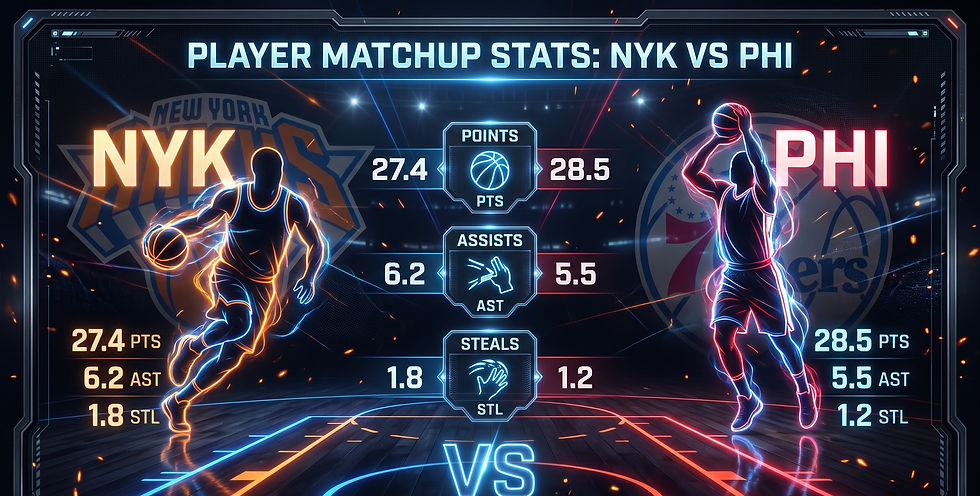
Knicks vs 76ers Match Summary
The Philadelphia 76ers entered the fourth quarter with an advantage created by their third-quarter performance. New York had been competitive during the first half, but Philadelphia's improved scoring after halftime changed the direction of the contest.
Match Detail | Information |
Teams | New York Knicks vs Philadelphia 76ers |
Date | October 20, 2026 |
Venue | Madison Square Garden |
Final Score | 76ers 106–100 Knicks |
Winning Team | Philadelphia 76ers |
Winning Margin | 6 points |
Top Scorer | Tyrese Maxey |
Maxey's Points | 28 |
Knicks' Leading Scorer | Jalen Brunson |
Brunson's Points | 21 |
The six-point margin indicates that New York remained within reach during the closing stages. However, Philadelphia's advantage after the third quarter gave it enough room to manage the final period and finish ahead.
Quarter-Wise Scorecard
Quarter | Philadelphia 76ers | New York Knicks |
First Quarter | 23 | 25 |
Second Quarter | 31 | 33 |
Third Quarter | 29 | 18 |
Fourth Quarter | 23 | 24 |
Final Score | 106 | 100 |
The Knicks scored 58 points during the first half, two more than Philadelphia. Their opening performance kept the game close and gave them a chance to build momentum at home.
The third quarter became the turning point. Philadelphia scored 29 points and limited New York to 18, creating an 11-point advantage for the period. The 76ers used this stretch to move in front and establish control of the contest.
New York responded with 24 points in the fourth quarter, but Philadelphia added 23 of its own. The Knicks improved their scoring output, yet the difference created in the previous quarter proved difficult to overcome.
Philadelphia 76ers Player Performance
Philadelphia's win involved contributions from several players. Maxey provided the main scoring threat, while other members of the rotation helped through shooting, rebounding, passing, and defense.
Player | Points | Rebounds | Assists |
Tyrese Maxey | 28 | 4 | 5 |
Jaylen Brown | 19 | 8 | 6 |
LeBron James | 14 | 9 | 7 |
Joel Embiid | 13 | 11 | 6 |
Anfernee Simons | 13 | 2 | 0 |
Kentavious Caldwell-Pope | 10 | 4 | 1 |
VJ Edgecombe | 9 | 4 | 1 |
Editorial note: Verify this player list and the associated statistics against the official box score before publishing. Some listed player-team combinations may be inaccurate.
Tyrese Maxey's Scoring Impact
Tyrese Maxey led the 76ers with 28 points. His ability to create scoring opportunities was a major feature of Philadelphia's offensive performance.
Maxey is known for using speed, changes of direction, and aggressive drives to challenge defenders. These skills can help a guard create space for jump shots or force defenders to commit fouls. In a competitive matchup, the ability to score without relying entirely on set plays gives an offense additional flexibility.
Beyond his scoring, Maxey contributed five assists and four rebounds in the listed figures. His passing helped involve teammates, while his offensive threat forced New York to pay attention to his movement and shot attempts.
A strong scoring performance from a lead guard can influence an entire team's approach. Defenders may need to provide help coverage, which can leave other players with more room to operate. Maxey's contribution therefore extended beyond his personal point total.
Jaylen Brown's All-Around Contribution
Jaylen Brown was listed with 19 points, eight rebounds, and six assists. His contribution across three statistical categories offered Philadelphia another source of production.
Scoring remains important, but rebounds and assists can be equally valuable in the right situations. Rebounds help secure possession, while assists demonstrate how a player helps teammates create scoring opportunities.
A balanced performance can also make a team's offense harder to defend. When multiple players can handle the ball and make decisions, the opposing defense cannot concentrate exclusively on the primary scorer.
LeBron James as a Playmaker
LeBron James recorded 14 points, nine rebounds, and seven assists in the listed statistics. His seven assists were the highest total among Philadelphia's listed players.
Playmaking helps an offense maintain its rhythm. A player who can identify open teammates, recognize defensive rotations, and make timely passes can help produce efficient possessions even when individual shooting is inconsistent.
James' nine rebounds also added value to his performance. Rebounding from the perimeter can help a team begin transition offense quickly and reduce the number of second-chance opportunities available to opponents.
Joel Embiid's Interior Presence
Joel Embiid finished with 13 points and 11 rebounds in the reported figures. His rebounding contribution helped Philadelphia compete near the basket.
A center can influence a game through interior scoring, screening, passing, rebounding, and rim protection. Even when the player is not the leading scorer, these responsibilities can shape how the opposition attacks the basket.
Embiid's ability to attract defensive attention can also create space for perimeter players. When a defense commits extra resources to guarding the paint, shooters and cutters may find more opportunities elsewhere.
Contributions from the Supporting Lineup
Anfernee Simons scored 13 points, while Kentavious Caldwell-Pope added 10. VJ Edgecombe contributed nine points.
These performances helped Philadelphia distribute its scoring. A team that receives points from multiple players can remain competitive when its leading scorer is closely guarded or experiences a difficult shooting stretch.
Supporting players also have responsibilities that do not always appear clearly in the box score. Screening, defensive communication, spacing, and making the correct pass all help create successful possessions.
New York Knicks Player Performance
The Knicks received their leading scoring contribution from Jalen Brunson. Karl-Anthony Towns and Josh Hart also provided important offensive production, while Andre Drummond led the rebounding effort.
Player | Points | Rebounds | Assists |
Jalen Brunson | 21 | 5 | 3 |
Karl-Anthony Towns | 19 | 12 | 1 |
Josh Hart | 14 | 7 | 3 |
Andre Drummond | 12 | 14 | 4 |
OG Anunoby | 10 | 5 | 0 |
Jose Alvarado | 8 | 3 | 3 |
Landry Shamet | 5 | 2 | 4 |
Mikal Bridges | 4 | 3 | 1 |
Jordan Clarkson | 4 | 1 | 1 |
Miles McBride | 3 | 1 | 1 |
Editorial note: Confirm all player statistics and roster details using the official game box score before publication.
Jalen Brunson Leads New York
Jalen Brunson scored 21 points, making him the Knicks' leading scorer in the reported matchup. His role includes creating shots, organizing the offense, and making decisions under defensive pressure.
Brunson can score through drives, midrange shots, perimeter attempts, and free throws. These different options allow him to remain an offensive threat even when a particular type of shot is not available.
However, individual scoring totals do not tell the complete story. Shooting efficiency, turnovers, assists, and the timing of points all influence a player's overall contribution. For New York, finding ways to generate efficient offense during difficult stretches remains important.
Karl-Anthony Towns' Double-Double
Karl-Anthony Towns recorded 19 points and 12 rebounds, producing a double-double. His ability to contribute both inside and outside the paint gives the Knicks an important offensive option.
A big man who can shoot from long range may force opposing centers to defend farther from the basket. That can open driving lanes for guards and create space for teammates to move without the ball.
Towns' rebounding also helped New York finish with 53 total rebounds. Nevertheless, team rebounding alone could not compensate for Philadelphia's advantage in shooting accuracy and ball movement.
Andre Drummond Controls the Boards
Andre Drummond was listed with 12 points and 14 rebounds. His rebounding total was the highest in the matchup.
Offensive rebounds are especially useful because they create additional opportunities after missed shots. Defensive rebounds end the opponent's possession and allow the team to transition into offense.
Drummond's work around the basket was one of the Knicks' statistical strengths. His contribution demonstrates why centers can influence games even when they do not lead their teams in scoring.
Josh Hart Provides Multiple Contributions
Josh Hart recorded 14 points and seven rebounds. His contribution in several areas helped the Knicks maintain offensive activity.
Players who rebound effectively from the wing can improve a team's transition opportunities. Instead of waiting for a center to collect the ball, a guard or forward may secure the rebound and quickly initiate a fast break.
Hart's scoring also provided support for Brunson and Towns. New York benefits when several players can contribute rather than relying on one or two individuals to generate most of its offense.
Other Knicks Contributors
OG Anunoby was listed with 10 points and five rebounds. Jose Alvarado contributed eight points and three assists, while Landry Shamet added five points and four assists.
Mikal Bridges, Jordan Clarkson, and Miles McBride also appeared in the reported statistical breakdown. Their contributions were smaller in scoring terms, but rotation players can still influence the outcome through defense, ball movement, and their ability to execute specific assignments.
Team Statistics: Knicks vs 76ers
Team statistics help explain how Philadelphia won despite New York's rebounding advantage.
Statistical Category | 76ers | Knicks |
Points | 106 | 100 |
Field Goals Made | 37 | 35 |
Field Goals Attempted | 89 | 94 |
Field-Goal Percentage | 41.6% | 37.2% |
Three-Pointers Made | 11 | 11 |
Three-Pointers Attempted | 40 | 33 |
Three-Point Percentage | 27.5% | 33.3% |
Free Throws Made | 21 | 19 |
Free Throws Attempted | 27 | 27 |
Total Rebounds | 45 | 53 |
Assists | 28 | 21 |
Steals | 8 | 6 |
Blocks | 10 | 8 |
Turnovers | 10 | 14 |
Philadelphia made 37 field goals compared with New York's 35. Although the difference in made shots was small, the 76ers attempted five fewer field goals and finished with a higher overall field-goal percentage.
New York was more accurate from three-point range, converting 33.3% of its attempts compared with Philadelphia's 27.5%. However, both teams made 11 three-pointers, so the Knicks' higher percentage did not translate into more three-point baskets.
The biggest statistical differences appeared in assists and turnovers. Philadelphia recorded seven more assists and committed four fewer turnovers. Those advantages helped the 76ers create and maintain their scoring opportunities.
Rebounding Battle and Second-Chance Opportunities
The Knicks finished with 53 rebounds, compared with 45 for Philadelphia. This eight-rebound difference was one of New York's strongest statistical advantages.
Rebounding is important because it determines which team controls missed shots. Defensive rebounds can end an opponent's possession, while offensive rebounds can create second-chance points.
Drummond's 14 rebounds and Towns' 12 rebounds helped the Knicks compete physically near the basket. Philadelphia, meanwhile, received rebounding contributions from Embiid, James, Brown, and other players.
The difference between individual and team rebounding is worth remembering. One player may record a high total, but the entire team must contribute to limit second chances and secure possession.
Despite winning the rebounding battle, New York did not win the game. This demonstrates that rebounding is only one part of basketball performance. Shooting efficiency, turnovers, free throws, and offensive execution can outweigh an advantage in a single statistical category.
Assists, Turnovers and Ball Movement
Philadelphia recorded 28 assists, while New York finished with 21. This difference suggests that the 76ers created more assisted scoring opportunities during the contest.
Ball movement can help an offense attack defensive weaknesses. Quick passes may force defenders to rotate, creating open shots or driving lanes. Teams that move the ball effectively can also make it more difficult for the defense to focus on a single scorer.
Turnovers had the opposite effect. New York committed 14 turnovers compared with Philadelphia's 10. Each turnover represents a lost possession and can give the opposing team an opportunity to score before the defense becomes organized.
A team can rebound well and still struggle if it gives away possessions. The Knicks' combination of more rebounds but more turnovers illustrates why basketball statistics must be evaluated together.
Key Factors Behind Philadelphia's Victory
Several aspects of the game help explain the final result.
Third-quarter scoring: Philadelphia's 29–18 advantage in the third quarter created the most significant shift in the game.
Maxey's production: His 28 points provided a dependable scoring source and helped the 76ers maintain offensive pressure.
Field-goal efficiency: Philadelphia converted a higher percentage of its field-goal attempts than New York.
Assists: The 76ers recorded 28 assists, demonstrating greater overall passing production in the reported statistics.
Turnover control: Philadelphia committed fewer turnovers, helping it preserve possessions and avoid giving the Knicks additional opportunities.
New York's rebounding advantage: The Knicks won the battle on the boards, but that advantage was not enough to offset their lower field-goal percentage and higher turnover total.
Frequently Asked Questions
Who won the Knicks vs 76ers game?
The Philadelphia 76ers defeated the New York Knicks 106–100 on October 20, 2026.
Who was the top scorer?
Tyrese Maxey was listed as the top scorer with 28 points for Philadelphia. Jalen Brunson led New York with 21 points.
How many rebounds did Andre Drummond record?
Andre Drummond was listed with 14 rebounds, the highest individual total in the matchup.
How many points did Karl-Anthony Towns score?
Karl-Anthony Towns scored 19 points and collected 12 rebounds in the reported statistics.
Which team had more assists?
Philadelphia recorded 28 assists, compared with New York's 21.
Which team won the rebounding battle?
The Knicks collected 53 rebounds, while the 76ers recorded 45.
What was the decisive quarter?
The third quarter was the turning point. Philadelphia outscored New York 29–18, creating an advantage that it maintained through the final period.
Why are player statistics useful?
Player statistics allow fans to evaluate scoring, shooting efficiency, rebounding, playmaking, and defensive contributions. Looking at several categories provides a more complete understanding than points alone.
Where should readers verify the final box score?
The official NBA box score is the best place to verify player names, team assignments, minutes, shooting figures, rebounds, assists, turnovers, steals, and blocks before publishing a match report.
The Knicks vs 76ers matchup demonstrated how a close NBA game can be decided by efficiency and execution rather than a single statistical category. Philadelphia's strong third quarter, Maxey's scoring, and the team's passing advantage helped secure the 106–100 win. New York's rebounding performance remained a positive, but its turnovers and lower field-goal percentage made it difficult to recover. Together, these numbers provide a useful framework for understanding the contest and evaluating the performances of both teams.


Comments